Getting a quote for a water softener can feel overwhelming, especially when prices seem to jump around with no clear explanation. You might see one installer quote $1,800 and another quote $4,500 for what sounds like the same thing. The difference is almost never random. It comes down to system type, water quality, installation complexity, and sometimes, what’s actually included in the price.
This guide walks you through what you should expect to pay, what drives those costs up or down, and how to read a quote with confidence. Whether you’re replacing an old unit or installing a softener for the first time, you’ll come away knowing what’s reasonable — and what isn’t.
How Much Does a Water Softener System Cost?
Most homeowners pay between $1,500 and $3,500 CAD for a professionally installed salt-based water softener. That total typically breaks into two parts: the unit itself, which runs $800–$1,800 CAD for a reliable mid-range system, and installation labour, which adds another $500–$1,500 CAD depending on the complexity of the job.
At the lower end of the spectrum, you’re looking at basic systems suited to smaller homes or moderately hard water. At the upper end, you’re getting into higher-capacity units, premium features like demand-initiated regeneration, or installs that require more plumbing work. Systems that pair a softener with reverse osmosis — common for Ontario well water where nitrates or arsenic are a concern — can run $3,500 to $7,000 CAD or more.
| System Tier | Unit Cost (CAD) | Installed Cost (CAD) |
|---|---|---|
| Basic | $400 – $800 | $900 – $1,500 |
| Mid-range | $800 – $1,500 | $1,500 – $2,500 |
| Premium / High-Capacity | $1,500 – $3,000+ | $2,500 – $5,000+ |
| Softener + RO Combo | $2,000 – $4,500 | $3,500 – $7,000+ |
Suggested Read: The Cost of Water Filtration Systems in Ontario: A Complete Guide
Cost of Water Softener by Type
Not all water softeners work the same way, and the type of system you need should be driven by what’s actually in your water — not just price or preference. Here’s a breakdown of the main options available to Ontario homeowners.
Salt-based ion exchange softener
This is the most common solution for hard water and can cost between $1,500 to $4,000 CAD installed. The system passes water through a resin bed that swaps calcium and magnesium ions — the minerals that cause hardness — for sodium. The result is genuinely soft water throughout your home. For Ontario water, which often tests at 20 grains per gallon or higher, a salt-based system is almost always the right starting point.
Dual-tank softener
A dual-tank system uses two resin tanks that alternate service cycles, so one is always active while the other regenerates. This makes sense for large households with five or more people, or in situations where water demand is continuous. This type of water softner typically cost between $2,500 to $5,000 CAD installed.
Salt-free conditioner
Salt-free systems, sometimes called template-assisted crystallization (TAC) conditioners, don’t remove hardness minerals — they change the form of the minerals so they’re less likely to stick to surfaces and form scale. If your main concern is protecting pipes and appliances from buildup, this can work. But you won’t get the slick feel of softened water, and these systems are less suited to very hard water or water that also contains iron. They’re marketed aggressively, so it’s worth knowing the distinction before you commit. You can expect the price of salt-free conditioner to be between $1,200 to $3,500 CAD installed.
Magnetic and electronic descalers
These devices clamp onto your incoming water pipe and claim to alter mineral behaviour using magnetic or electronic fields. The evidence for their effectiveness is limited, and most water treatment professionals don’t recommend them as a primary solution. They’re worth mentioning only because they appear frequently in searches and can look like a bargain costing $100 – $500, compared to a proper softener.
Water softener with reverse osmosis
A softener and a reverse osmosis (RO) system solve different problems. The softener handles hardness throughout your home; the RO system sits under the kitchen sink and provides filtered drinking water free of nitrates, arsenic, sodium, and other contaminants that a softener leaves behind. For many Ontario well-water homeowners — especially those with elevated nitrates or arsenic on their water test — this combination gives complete coverage. The two systems are often quoted together, which is why all-in prices at this tier can seem high costing $3,500 to $7,000+ CAD installed.
What Affects the Cost of a Water Softener?
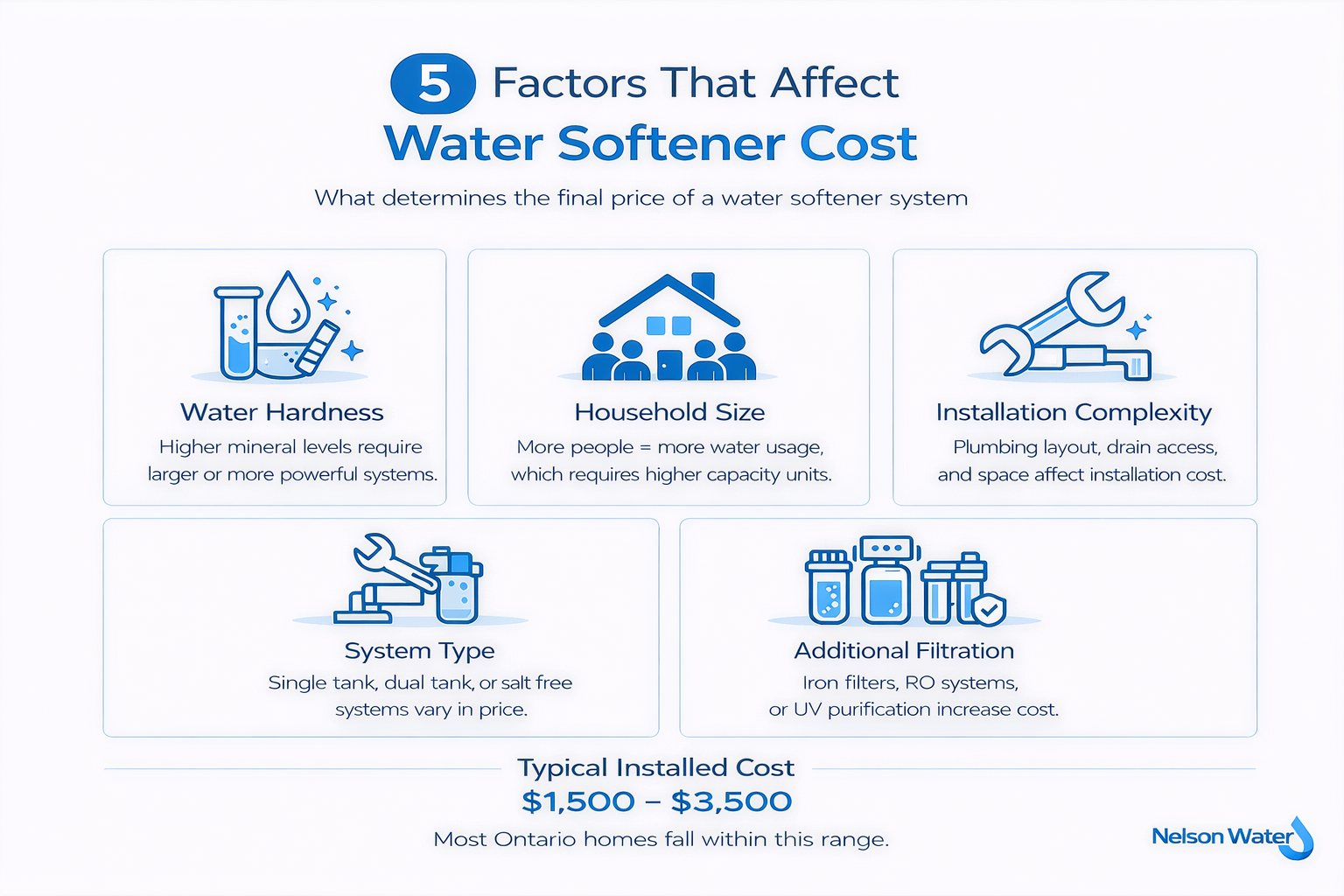
Two homeowners in the same city can receive quotes that differ by a thousand dollars or more for what sounds like a similar system. Here’s what actually drives those differences.
Your water hardness level
Hardness is measured in grains per gallon (gpg) or milligrams per litre (mg/L). Ontario water commonly tests between 20 and 40+ gpg, which is considered very hard. The harder your water, the higher the grain capacity you need in a softener — and capacity affects price. A higher-capacity unit costs more upfront, but it regenerates less often and uses salt more efficiently over time. If you’re not sure of your hardness level, a water test is the only reliable starting point.
Suggested Read: Understanding Water Hardness Setting Numbers
Iron, manganese, or sulphur in your water
These are common in Ontario well water, and they matter for your softener budget because they can damage the resin bed if they’re not addressed before the water reaches the unit. Depending on your test results, your installer may recommend an iron filter or an oxidizing pre-filter upstream of the softener. This isn’t an unnecessary add-on; it protects the system you’re investing in.
Household size and daily water use
Softeners are sized based on the amount of hardness they need to remove each day, which is a function of your water’s hardness level multiplied by your household’s daily water consumption. A family of six uses significantly more water than a retired couple, and needs a proportionally larger system. Getting this sizing right matters: an undersized unit will regenerate too often, wear out faster, and use more salt than necessary. Ask your installer to show you the calculation; any reputable provider will have done this before recommending a system size.
System features and regeneration style
Entry-level softeners regenerate on a fixed timer, regardless of how much water your household actually used. Mid-range and premium systems use demand-initiated regeneration (DIR), which triggers a cycle only when the resin is actually exhausted. DIR systems use 30 to 50 percent less salt and are gentler on the resin over time. The price difference between a timed system and a DIR system is usually a few hundred dollars — and it pays for itself fairly quickly in salt savings.
Installation complexity
A straightforward install in an open utility room with existing plumbing and a nearby floor drain takes two to three hours. An install that requires running a new drain line, working in a tight mechanical room, dealing with older iron pipe plumbing, or setting up multiple treatment units in sequence can take considerably longer. Since labour accounts for 25 to 40 percent of most quotes, the complexity of your site has a real effect on your final cost.
Local labour rates
Plumbing and water treatment labour in Ottawa and across Ontario typically runs $85 to $150 per hour. Add in the fact that most water softener components are manufactured outside Canada and carry import costs, and you’ll consistently see prices that reflect those realities. Any guide quoting significantly lower figures is likely based on a different market.
Suggest Read: Well Water Testing in Ontario
Water Softener Installation Cost
Installation typically accounts for 25 to 40 percent of your total project cost, a meaningful portion that’s worth understanding before you get quotes. What you’re paying for is more than just someone connecting a few pipes.
A proper installation includes a site assessment, delivery and positioning of the unit, all plumbing connections including the bypass valve, a drain line for backwash, the initial salt load, system programming, and a full walkthrough so you understand how to operate and maintain the system. Done right, it takes two to four hours for a standard install.
Simple installation
This applies when there’s already an appropriate space for the softener, a nearby floor drain, and standard copper or PEX plumbing. Replacing an existing softener in the same location is the most straightforward version of this. Simple installation can range between $500 to $800 CAD.
Complex installation
This applies when the job requires running a new drain line, rerouting plumbing, working around older galvanized pipes, or installing multiple treatment units that need to be set up in sequence. Finished basements with limited access or no existing utility space can also push installation into this range. You can expect the cost of complex installation between $800 to $1,500+ CAD.
What’s Included in a Water Softener Quote?
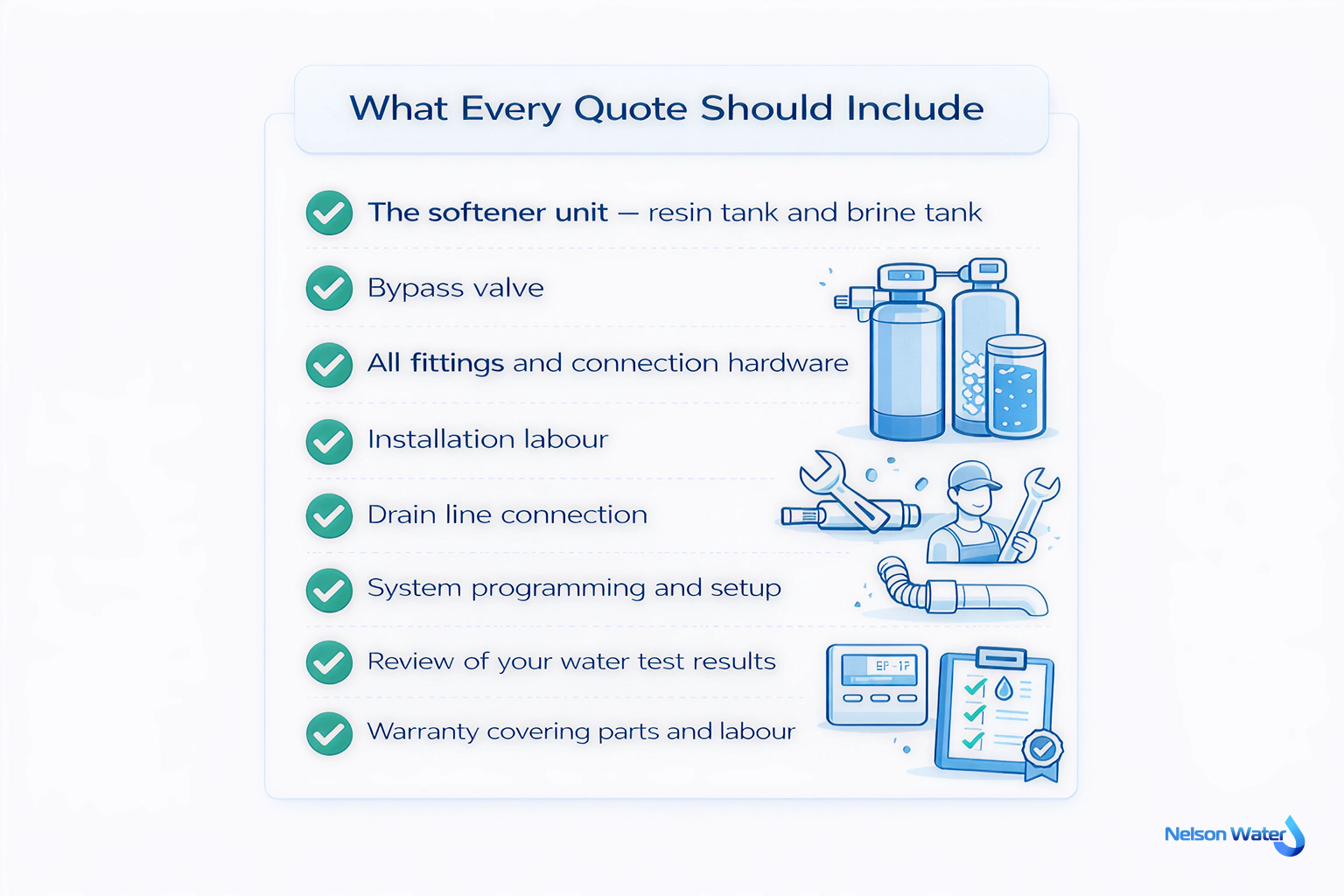
One of the most common frustrations homeowners have is receiving quotes that are hard to compare because they don’t show the same line items. A clear, itemized quote makes it easy to understand what you’re getting, and to spot anything that’s missing or added without explanation.
What every quote should include
- The softener unit — resin tank and brine tank
- Bypass valve
- All fittings and connection hardware
- Installation labour
- Drain line connection
- System programming and setup
- Review of your water test results
- Warranty covering parts and labour
If any of these items are missing from a quote, ask specifically about them. A trustworthy installer won’t hesitate to add the detail.
Add-ons that may appear and when they’re warranted
Some items show up on quotes that are genuinely necessary given your water quality, while others may not apply to your situation at all. For each add-on on your quote, ask your installer to explain which part of your water test result is driving the recommendation.
| Add-on | When it’s actually needed |
|---|---|
| Iron pre-filter | Iron above 0.3 mg/L on your water test |
| Sediment filter | Turbid or silty well water |
| Reverse osmosis system | Elevated nitrates, arsenic, or sodium at the drinking tap |
| Plumbing rerouting | Older homes with non-standard pipe layout |
| New electrical outlet | No outlet near the installation point |
| Permit or code work | Some municipalities require permits for residential plumbing work |
How to Tell if a Quote is Too High
A well-specified, professionally installed salt-based softener for an average Ontario home should fall somewhere between $1,800 and $3,000 CAD. That’s not a hard rule, and your situation may genuinely justify a higher number. But if a quote is above that range, it’s worth understanding exactly why.
Here are the signs that a quote may not be giving you the full picture.
- No itemization. A single lump sum with no breakdown makes it impossible to understand what you’re paying for. Ask for a line-by-line quote, and if the installer resists, that tells you something.
- Add-ons that weren’t discussed. If an iron filter, UV system, or RO unit appear on the quote without your installer having reviewed a water test with you first, ask specifically which test result is driving each recommendation.
- A system sized beyond your household needs. A 48,000-grain unit for a two-person home is almost certainly more than required. Ask your installer to walk you through the sizing calculation — it should be based on your actual hardness level and daily water use.
- Quoting before testing. Any reputable water treatment provider should review or perform a water test before recommending a system. A quote that arrives without any discussion of your water quality is a quote based on assumptions, not your actual situation.
- Pressure-based language without data. Statements like “your appliances are being destroyed” without showing you actual test results are worth being skeptical of. Ask to see the numbers.
The straightforward fix: Start with a water test. Once you know what’s in your water, recommendations become much easier to evaluate — and you’re in a much stronger position when comparing quotes.
Water Softener Cost in Ontario
Pricing guides for water softeners are often written with a broad national audience in mind, which means they don’t always reflect what Ontario homeowners actually encounter. A few factors make this province — and particularly the Ottawa region and Eastern Ontario — worth addressing separately.
Labour rates for licensed plumbers and water treatment specialists in Ontario typically run $85 to $150 per hour. Most water softener equipment is also imported, which means local pricing reflects shipping, duties, and distributor margins that aren’t always captured in generic cost guides. Together, these factors mean that installed costs in Ontario tend to land toward the middle or upper end of any national range you’ll find online.
Well water is also much more common outside Ontario’s major urban centres, and well water in this part of the province tends to be hard — often in the 20 to 40+ gpg range in Eastern Ontario, including the Ottawa region. That level of hardness usually requires a higher-capacity softener than many online calculators suggest. And because well water also commonly contains elevated iron, manganese, or hydrogen sulphide, it’s not unusual for a complete treatment solution to include more than just a softener.
Ongoing Costs to Budget For
The installed price is what gets most of the attention, but a water softener also has real operating costs that are worth factoring into your decision. None of them are prohibitive, but they should be part of your planning.
Salt
Salt is the main ongoing expense. A typical Ontario household uses four to ten bags of water softener salt per month, at roughly $8 to $15 CAD per bag depending on the type and where you buy it. Actual consumption depends on your water’s hardness level, your household size, and how often the system regenerates. If your system uses demand-initiated regeneration, salt use tends to fall on the lower end of that range — DIR systems are meaningfully more efficient than timed systems.
Annual maintenance
An annual service visit is worth scheduling even when the system seems to be running fine. A technician will inspect the resin condition, check the brine draw mechanism, sanitize the tank, and run a water test to confirm the system is performing correctly. Problems that go undetected — like a slow salt bridge or declining resin capacity — tend to show up gradually and cost more to address later. The Water Quality Association offers consumer-facing guidance on softener maintenance and what to look for between service visits.
Resin replacement
Quality resin lasts a long time under normal conditions — typically 10 to 15 years. High iron levels in your feed water or exposure to chlorine can degrade resin faster. When a system starts softening less effectively, testing the resin is usually one of the first steps an installer will take.
Electricity
Water softeners use a minimal amount of electricity — roughly equivalent to a clock radio. It won’t have a noticeable effect on your hydro bill.
DIY vs. Professional Water Softener Installation
Installing a water softener yourself is possible in the right circumstances, and it can save $500 to $1,000 CAD in labour costs. But it carries real risks if the conditions aren’t right — and those risks can end up costing more than the labour you saved.
When DIY makes sense
If you’re replacing an existing softener in the same location, have basic plumbing experience, and your home has straightforward copper or PEX plumbing with a drain nearby, a self-install is a reasonable option. Many homeowners do this successfully, especially when switching to a newer unit of the same footprint.
When to hire a professional
New installs, well water with complex chemistry, older homes with galvanized pipe, or projects that involve staging multiple treatment units — a softener paired with an iron filter, for example — are better left to a professional. Getting the sizing, sequencing, and programming right in these situations matters more than the labour cost saved. A system that’s undersized, incorrectly plumbed, or programmed without accounting for your water chemistry won’t perform the way it should.
Before going DIY: Check the warranty terms on the unit you’re buying. Many manufacturers and dealers will not honour warranties on self-installed systems. Confirm this before you purchase.
How Long Does a Water Softener Last?
A well-maintained salt-based water softener will typically last 15 to 20 years. Less expensive units may start to decline after 8 to 10 years, particularly if maintenance has been inconsistent or the water quality was harder on the resin than expected. The most common reasons for early failure are high iron levels that weren’t addressed upstream, salt bridges that form when the brine tank isn’t checked regularly, and skipped annual service visits that allow small problems to compound over time.
When repair costs start to approach 50 percent of what a new unit would cost, replacement usually makes more financial sense. A good installer will tell you this honestly.
What soft water actually protects
The long-term value of a softener comes from what it prevents. A study by the Water Quality Association found that softened water can extend water heater life by 25 to 50 percent and reduce energy consumption by up to 29 percent, because scale buildup forces water heaters to work significantly harder over time.
- Appliances: Dishwashers, washing machines, and coffee makers all fail earlier in hard water. Scale accumulates on heating elements and internal components, and it’s one of the leading causes of premature appliance breakdown.
- Plumbing: Scale builds up inside pipes over years, gradually reducing flow and eventually requiring costly intervention. This is particularly relevant in older Ontario homes where the plumbing has had decades to accumulate mineral deposits.
- Cleaning products: Hard water reduces the effectiveness of soap and detergent, leading households to use more product than they need. Softened water homes typically use 50 to 75 percent less detergent, shampoo, and cleaning products — a saving that adds up across a year.
- Comfort: Many people notice a real difference in how their skin and hair feel after switching to soft water — less dryness, less residue, and better lather in the shower.
For most Ontario households with genuinely hard well water, the math works in favour of a softener. When you account for reduced appliance wear, lower energy costs, and savings on cleaning products, a properly sized system typically pays for itself within three to six years —and then continues to deliver value for another decade or more.
Get a Free Quote and Understand Your Water Softener Needs
If you’re not sure what your water needs or want a second opinion on a quote, Nelson Water offers free in-home consultations for Ottawa-area homeowners. We test your water, explain what we find, and provide a quote based on your results. The visit takes about an hour.
Frequently Asked Questions
How much does a water softener cost in Ontario?
Most homeowners pay $1,500 to $3,500 CAD for a professionally installed salt-based system. If your water also requires iron filtration or a reverse osmosis system, expect to budget $4,000 to $7,000 CAD or more for the complete solution.
Is a $5,000 quote too high for a standard water softener?
For a softener alone with no significant add-ons, $5,000 would be on the high end. That said, a $5,000 quote may be entirely reasonable if it includes an iron pre-filter, RO system, or more complex installation work. The key is to ask for a fully itemized breakdown so you can see exactly what’s driving the price.
Do I need a reverse osmosis system with my softener?
Not necessarily. A softener removes hardness minerals but leaves behind other contaminants like nitrates, arsenic, and the small amount of sodium introduced through the softening process. If your water test shows elevated nitrates or arsenic — which does occur in parts of Ontario — an RO system at the kitchen tap is a sensible addition. If hardness is your only concern, a softener on its own is sufficient.
How much does salt cost per year?
Budget $200 to $450 CAD annually, depending on your water hardness, household size, and the efficiency of your system. A system with demand-initiated regeneration (DIR) will typically land at the lower end of that range, since it only regenerates when the resin is actually exhausted rather than on a fixed schedule.
Can I install a water softener myself?
In straightforward situations, particularly when replacing an existing unit — yes. For new installs with complex chemistry, older plumbing, or multiple treatment components, professional installation is a better choice. Always check the manufacturer’s warranty terms before committing to a self-install, as some warranties are void without professional installation.
How do I know what size water softener I need?
Sizing is based on your water hardness multiplied by your household’s daily water consumption. A water test is the essential first step — not an estimate or a guess. Ontario water commonly tests at 20 to 40 grains per gallon or higher, which puts most households well above what many generic online sizing calculators assume.
Should I get multiple quotes?
Yes. Two or three quotes give you a realistic picture of what local pricing looks like and make it much easier to spot anything that seems out of place. Compare line items, not just totals — a lower quote that doesn’t include a necessary component isn’t actually cheaper.