If your home runs on a private well, you already know the advantages. No water bills, independence from municipal supply, and often high-quality, naturally filtered groundwater.
What’s less obvious is the responsibility that comes with it.
Unlike homes connected to a municipal system, private wells in Ontario are not monitored by any government body. The province doesn’t test your water, doesn’t send alerts, and doesn’t follow up. Under Ontario’s Safe Drinking Water Act, rigorous testing requirements apply to municipal systems only. Private well owners are on their own.
That makes regular well water testing the single most important thing you can do to protect your family’s health and your home’s infrastructure.
This guide covers everything Ontario homeowners need to know: what to test for, how often to test, how to interpret your results properly, and how to choose the right treatment if anything comes back above safe levels.
Why Well Water Testing Matters More Than Most Homeowners Realise
The most common misconception about well water is that clear, good-tasting water is safe.
It isn’t, necessarily.
The contaminants that pose the most serious health risks, such as arsenic, nitrates, and certain bacteria, are often completely undetectable by sight, smell, or taste. Your water can look and taste perfectly fine while containing levels of arsenic or nitrates that exceed Health Canada’s guidelines.
Another major factor to consider is that groundwater also isn’t static. It moves through rock and soil, picking up whatever it encounters along the way. Seasonal changes, nearby agricultural activity, aging well infrastructure, and land use shifts in your area can all change what’s in your water. Sometimes quickly.
A test done two or three years ago tells you what your water contained then, not now. This is especially relevant in eastern Ontario, where the limestone and shale bedrock naturally releases iron, manganese, and arsenic into groundwater, and where agricultural land use near wells is common.
The other factor most well owners underestimate is their own infrastructure. Your well pump and pressure tank are part of the system. Aging seals, deteriorating wellhead components, and pressure fluctuations after power outages are all pathways for surface contamination to enter an otherwise clean well. Regular testing catches these events before they become a prolonged exposure problem.
How Often Should You Test Your Well Water?
Testing frequency can vary depending on what you’re testing for. This can range from three times a year to once every two years, or any changes that arise. Let’s take a closer look.
Bacteria Testing: Three Times Per Year
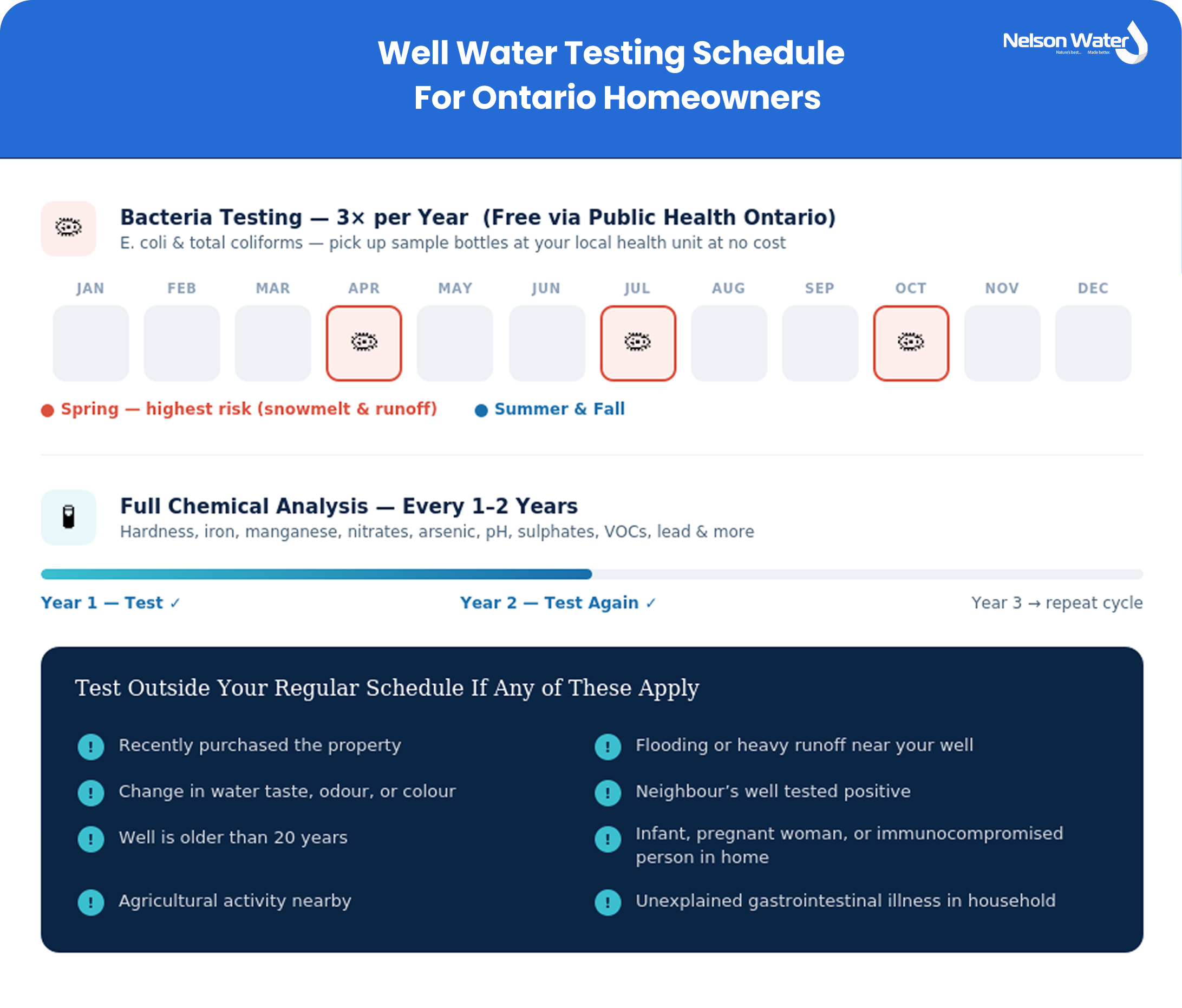
Ontario Public Health recommends testing well water for bacteria, specifically E. coli and total coliforms, at a minimum of three times per year: spring, summer, and fall.
Spring testing matters most. Snowmelt and heavy spring rainfall push surface water toward wellheads, and bacterial contamination events are most likely during this period. Summer and fall testing catches any changes that developed over the warmer months, when biological activity in soil and groundwater is highest.
Public Health Ontario offers free bacteriological testing through provincial laboratories. Ottawa-area homeowners can access this through the Eastern Ontario Health Unit, where you pick up sample bottles at no cost. Given that it’s free and takes minimal effort, there’s no good reason to test bacteria less than three times a year.
Chemical and Mineral Testing: Every One to Two Years
Bacteria testing alone doesn’t give you the full picture. A comprehensive chemical analysis, covering hardness, iron, manganese, nitrates, arsenic, pH, sulphates, sodium, and turbidity, should be done every one to two years as a baseline, and more frequently if any of the following apply:
- You’ve recently purchased the property and don’t have your own baseline test
- There has been flooding, significant runoff, or nearby construction
- You’ve noticed any change in taste, odour, or the appearance of your water
- A neighbouring well has tested positive for contamination
- Your well is older than 20 years
- There is agricultural activity within a few kilometres of your property
- A household member experiences unexplained gastrointestinal illness
- There are infants, pregnant women, elderly individuals, or immunocompromised people in the home
Any one of these conditions changes the risk profile enough to justify testing sooner rather than later.
What Does Well Water Testing Actually Test For?
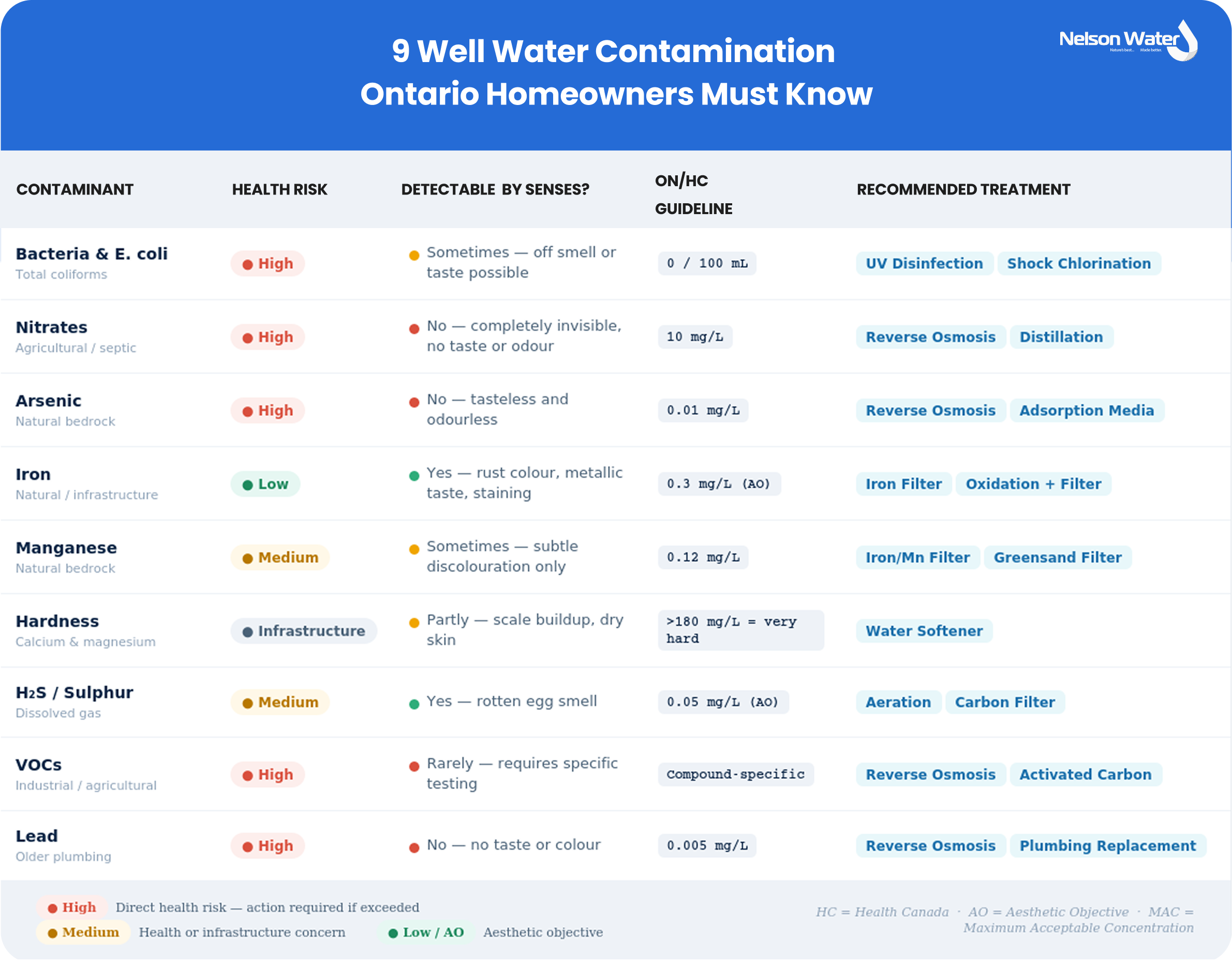
Here’s a thorough breakdown of what a comprehensive well water test covers and why each parameter matters.
Bacteria: E. coli and Total Coliforms
E. coli is the most serious bacterial indicator. Its presence means the water has been contaminated by fecal matter from septic systems, livestock, surface runoff, or wildlife. And this water is unsafe to drink without treatment.
Total coliform bacteria are a broader indicator of contamination; their presence doesn’t always indicate a direct health risk, but it signals that the well’s integrity may be compromised and that further testing and inspection are warranted.
Bacterial contamination in wells most commonly follows heavy rainfall events, flooding, or infrastructure failure. The well may have been clean for years before a single event introduces contamination.
Nitrates and Nitrites
Nitrates are the chemical contaminant most associated with agricultural areas, but they appear in wells near older septic systems as well. They’re completely odourless and tasteless. At elevated concentrations (above Ontario’s standard of 10 mg/L), nitrates interfere with the blood’s ability to carry oxygen, posing a serious risk to infants under six months and pregnant women. For other adults, chronic exposure at elevated levels has been associated with adverse health outcomes in long-term research.
Iron and Manganese
Iron is common across Ontario groundwater and usually makes itself known through rust-coloured water, orange staining on fixtures and laundry, and a metallic taste. It’s not typically a health risk at concentrations found in wells, but it damages appliances, clogs plumbing, and makes water unpleasant.
Arsenic
Arsenic occurs naturally in Ontario bedrock, particularly in the limestone and granite formations common across eastern and northern Ontario. It’s tasteless, odourless, and colourless. Health Canada’s guideline is 0.01 mg/L. Arsenic risk is cumulative. It’s the result of long-term exposure, not a single glass of water, which is precisely why it goes undetected for so long in wells that have never been specifically tested for it.
A large number of Ontario wells exceed Health Canada’s arsenic guideline. Testing is the only way to know whether yours is one of them.
Hardness (Calcium and Magnesium)
Hard water is widespread in Ontario, and the Ottawa region sits firmly in high-hardness territory. Calcium and magnesium don’t pose health risks, but they create real problems for infrastructure and household systems: scale buildup in water heaters and boilers, reduced appliance efficiency and lifespan, soap scum and film on surfaces, and dry skin and hair after bathing.
pH
pH affects how corrosive your water is. Low pH (acidic water) can leach copper and lead from pipes and fixtures, even in relatively new plumbing. High pH can cause scale and reduce the effectiveness of disinfection systems. Most well water falls within an acceptable range, but testing confirms it.
Sulphates and Hydrogen Sulphide
Sulphates at high concentrations can cause a laxative effect, particularly for people not accustomed to them. Hydrogen sulphide gas in water produces the characteristic rotten egg smell. It is one of the few well water problems that announces itself. Both are treatable but require a confirmed diagnosis before selecting the right approach.
Volatile Organic Compounds (VOCs)
VOCs (solvents, fuel components, pesticide residues) enter groundwater from industrial activity, underground storage tanks, dry cleaning operations, and agricultural runoff. They’re not included in standard testing panels and require specific analysis. If your property has any history of nearby industrial or heavy agricultural activity, or if you’re near a former gas station or industrial site, VOC testing belongs on your list.
Lead
Lead doesn’t typically originate from groundwater itself but from aging plumbing, particularly older fixtures, solder, and service lines in homes built before the 1990s. If your home has older plumbing, testing for lead at the tap is worth adding to a comprehensive analysis.
Free Public Testing vs. Comprehensive Professional Testing
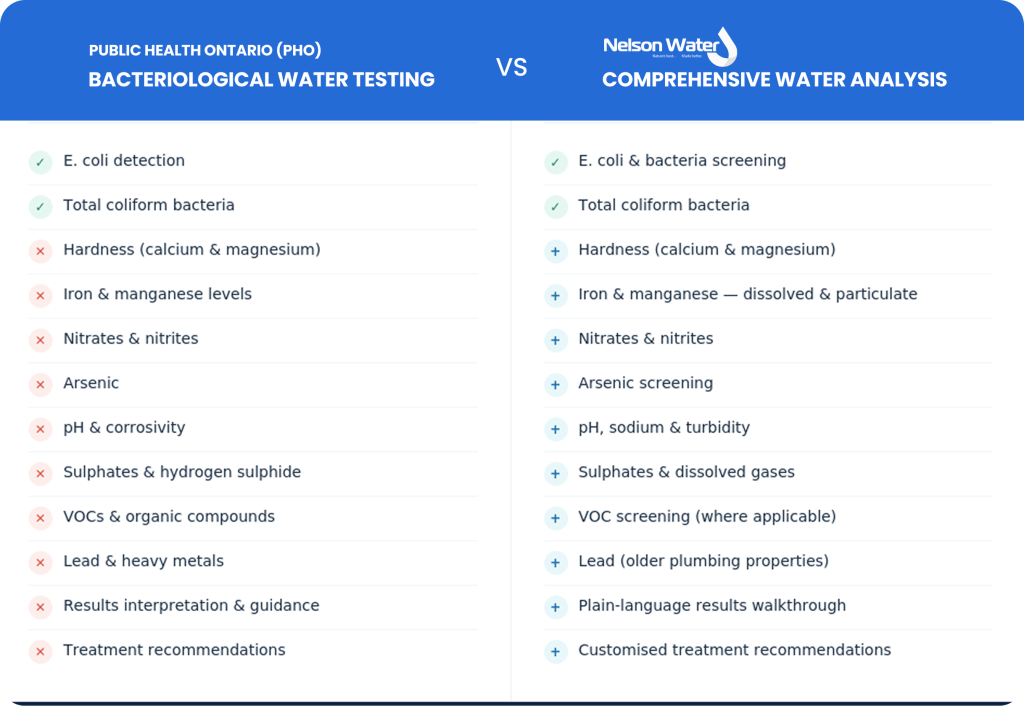
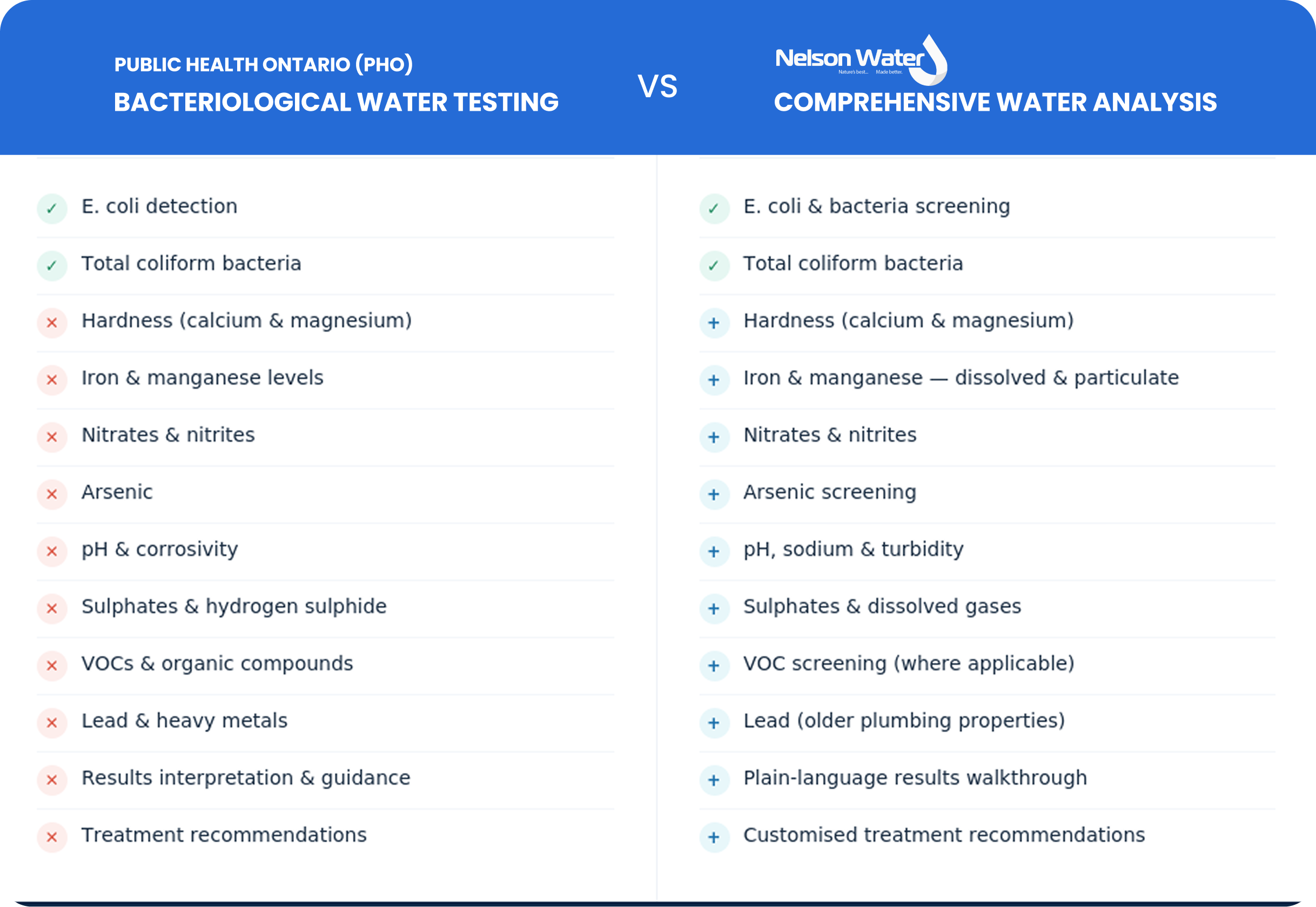
Free bacteriological testing through Public Health Ontario, available through local health units including the Eastern Ontario Health Unit, covers E. coli and total coliforms. It’s a genuinely useful program and every well owner should take advantage of it three times a year.
But a clean bacteria result does not mean your water is chemically safe. The two assessments measure entirely different things.
A comprehensive professional water analysis covers the full chemical and mineral picture: hardness, iron, manganese, pH, nitrates, arsenic, sulphates, sodium, turbidity, and more. It tells you not just whether bacterial contamination is present, but what your water actually contains, and at what concentrations relative to Ontario and Health Canada guidelines.
Nelson Water’s in-home water analysis goes further than a lab report alone. You get a full explanation of your results in plain language, context for what the numbers mean for your specific household, and honest recommendations about what needs to be addressed.
What to Do When Well Water Testing Reveals a Problem
The good news is that most well water issues are treatable. The important thing is matching the treatment to the specific contaminant identified in the test, rather than buying equipment first and hoping it covers the problem.
For bacteria: A UV disinfection system is the standard and most effective approach for private wells. UV light destroys bacteria and viruses without adding any chemicals to the water, doesn’t affect taste, and requires minimal maintenance. It’s one of the most reliable technologies available for this specific problem.
For iron and manganese: A dedicated iron removal filtration system is required, but the right type depends on what form the iron takes in your water. Dissolved ferrous iron, particulate ferric iron, and iron bacteria are three different problems that respond to different treatment approaches. Testing first, treating second — not the other way around.
For nitrates: Reverse osmosis at the point of use — a system installed under the kitchen sink for drinking and cooking water — is the most practical and cost-effective solution. It’s highly effective at reducing nitrates to safe levels.
For arsenic and VOCs: Reverse osmosis addresses a wide range of these contaminants effectively. Depending on the specific compounds and concentrations in your test, specialized filtration media may be more appropriate. A professional assessment of your results will point you toward the right system.
For hard water: A properly sized water softener is the proven solution. Sizing is based on your household’s daily water consumption and your measured hardness level — two variables that a test result and a conversation with a professional will clarify.
For hydrogen sulphide: Aeration and filtration systems remove sulphur gas effectively. This is one of the few problems where the diagnosis is usually obvious before testing, but testing confirms the concentration and guides the treatment specification.
Well Water Testing When Buying or Selling a Property
If you’re purchasing a home with a private well, water testing should be a non-negotiable part of your due diligence, not just an optional add-on.
Request the most recent water test results from the seller and check the date. Anything older than one to two years for chemistry, or older than a few months for bacteria, means you don’t have current data. Arrange an independent test before finalizing the purchase, and factor any treatment requirements into your negotiations.
For sellers, testing before listing is worth doing for practical reasons. If a problem exists, you’d rather know about it in advance than have it surfaced during a buyer’s inspection. Documented clean results strengthen buyer confidence and reduce the chance of last-minute complications.
The Bottom Line
Well water testing isn’t a one-time task. It’s an ongoing part of responsible well ownership in Ontario. It should be done three times a year for bacteria, every one to two years for a full chemical analysis, and any time something changes on your property or in your water.
The cost of testing is minimal. Bacterial testing is free, and a full chemical test from professionals is available at a little cost. But what you get back is an accurate picture of your water, which is the only basis for making informed decisions about treatment.
If you haven’t tested recently, or if you have results you’re not sure how to interpret, Nelson Water’s free in-home water analysis is the right starting point. We’ve been working with Ottawa-area homeowners for over 30 years. We know Ontario groundwater, we know local conditions, and we give you straight answers — not a sales pitch.
Our water system maintenance services are also available for homeowners who want ongoing support rather than managing testing schedules independently.
Book your free water test with Nelson Water →